Sunday, April 14, 2013

Notes on "In Parenthesis" pt. 3

Notes on David Jones' In Parenthesis, pt. 7
Jones, David. In Parenthesis: seinnyessit e gledyf ym pen mameu. New York: Chilmark Press, Print.

Part Seven, title page:

  • "Gododdin I demand thy support...has been found" - Y Gododdin
    • LII.
      "Gododdin! In respect of the I will demand
      The dales beyond the ridge of Drum Essyd;
      The slave, greedy of wealth, cannot control himself;
      By the counsel of thy son, let thy valour shine fourth.
      The place appointed for the conference
      Was not mean, in front of Llanveithin;
      From twilight to twilight he revelled;
      Splendid and full was the purple of the pilgrim;
      He killed the defenceless, the delight of the bulwark of toil,
      His inescapable companion, whose voice was like that of Aneurin."


      LXIII.
      It is incumbent to sing of the complete acquisition
      Of the warriors, who at Cattraeth made a tumultuous rout,
      With confusion and blood, and treading and trampling;
      Men of toil were trampled because of the contribution of mead in the horn; 
      But the carnage of the combatants 
      Cannot be described even by the cup of bounty,
      After the excitement of the battle is over,
      Notwithstanding so much splendid eloquence.


      LXIV.
      It is incumbent to sing of so much renown,
      The tumult of fire, of thunder, and tempest,
      The glorious gallantry of the knight of conflict. 
      The ruddy reapers of war are thy desire, 
      Thou man of toil, but the worthless thou beheadest; 
      The whole length of the land shall hear of thee in battle;
      With thy shield upon thy shoulder, thou dost incessantly cleave
      With thy blade, until blood flows like bright wine out of glass vessels; 
      As the contribution for mead thou claimest gold;
      Wine nourished was Gwaednerth, the son of Llywri.

      LXV.
      It is incumbent to sing of the gay and illustrious tribes,
      That, after the fatal fight, filled the river Aeron;
      Their grasp satisfied the hunger of the eagles of Clwyd,
      And prepared food for the birds of prey.
      Of those who went to Cattraeth, wearers of the golden chain,
      Upon the message of Mynyddawg, sovereign of the people,
      There came not honourably in behalf of the Brython,
      To Gododin, a hero from afar who was better than Cynon.

      LXVI.
      It is incumbent to sing of so many men of skill,
      Who in their halls once led a merry life:
      Ambitious and bold, all round the world would Eidol seek for melody;
      But notwithstanding gold, and fine steeds, and intoxicating mead,
      Only one man of these, who loved the world, returned,
      Cynddilig of Aeron, one of the Novantian heroes.

      LXVII.
      It is incumbent to sing of the gay and illustrious tribes,
      That went upon the message of Mynyddawg, sovereign of the people,
      And the daughter of Eudav the Tall, of a faultless gait,
      Apparelled in her purple robes, thoroughly and truly splendid.
      (text from Project Gutenberg)


    • If I am not very much mistaken, the verse as it appears on the title page, is an amalgamation of the sections bolded here. Differences in translation have made it difficult to be sure though. However, it would seem that the poet is demanding the support of Gododdin, the place/people who live there, to aid him in his duty to tell the tale of death, because "a meeting place has been found" (In Parenthesis 151). The above mentioned verses would seem to support such a reading, as they all focus on those who are either about to die, or have died - a fitting opening for the last part, in which all the characters end up dead. 
VII. 153:
  • "Invenimus eum...silvae"... "Matribus suis dixerunt ... suarum"
    • "We will come upon him in the forest camp"
    • "They said to the mother herself: where is the wheat and the wine? When they have fallen as if wounded... when they breathe out their lives on their mothers' laps."
      • The connection to the text is that, of course, that the men have all been killed in the forest.
VII. 155:
  • Olwen-trefoils
    • the bride of Culhwch, called so because, as Jones says, trefoils sprang up in her footsteps.
    • Original image found here.

  • Yspaddaden Pankwr
    • A giant. The father of Olwen, Culhwch's bride.
  • Twrch Trwyth
    • The boar which Culhwch must find, and from whom he must retrieve a comb and razor without being poisoned by his bristles (part of the supposedly impossible quest Yspaddaden sets for Culhwch).
  • All of these references are to the story of Culhwch and Olwen found in The Mabinogion, here relevant because they are Welsh, as is Aneirin Lewis, but also because the chemists can produce weapons more deadly than the poisoned bristles of Twrch Trwyth or his tusks. 
  • "fallen at Catraeth...Salisbury" 
    • Jones is referring to both the battle at Catraeth from Y Gododdin and the battle of Camlann from Le Mort d'Arthur, both disastrous battles. Death is the theme of the day.
VII. 163:
  • "Tristram...Oliver"
    • Heroes/warriors who all die during the course of their respective tales. 
VII.181:
  • "Captain Cadwaladr"
    • Presumably named for the 7th century king of Gwynedd who figured in Geoffrey of Monmouth's Historia Regum Britanniae and did not end particularly happily.
  • "And then he might see sometime the battle...castle"
    • From Le Mort d'Arthur, yet another bloody battle where just about everyone ends up dead.
VII. 185:
  • Some she gives White berries...Guenedota"
    • white berries
    • brown berries
    • Golden Saxifrage - affection, if anything like Mossy Saxifrage
    • Sweet-briar/Eglantine - "Poetry/I wound to heal"
    • Balder - must have had mistletoe (because of the Norse myth in which the god Balder is killed by a spear tipped with mistletoe) - "I surmount difficulties"
    • Myrtle - love/marriage/true love
    • daisies - innocence
    • Hansel with Gronwy - a German and a Welshman get the same flowers
    • dog-violets - (if they're the same as regular violets) loyalty/devotion/faithfulness
    • St. John's Wort - Animosity
    • Rowan/Mountain Ash - Prudence
      • In Celtic mythology, the Rowan tree is associated with magic and with protection
VII. 187:
  • For note on Oeth and Annoeth's hosts see here.
    • At the beginning, presumably Private John Ball's company is the host that fights so well in coverts and in the open, now it seems that that honour is left to the newer, younger men. 

So ends In Parenthesis. As I suspected from the many, many references to Y Gododdin, and all the depressing bits of Malory as well as from the context of WWI, everyone ends up dead. 

There was something in the overall tone that reminded me of William Morris, so I have included a passage from the first chapter of Morris' The House of the Wolfings.

"On either side, to right and left the tree-girdle reached out toward the blue distance, thick close and unsundered, save where it and the plain which it begirdled was cleft amidmost by a river about as wide as the Thames at Sheene when the flood-tide is at its highest, but so swift and full of eddies, that it gave token of mountains not so far distant, though they were hidden.  On each side moreover of the stream of this river was a wide space of stones, great and little, and in most places above this stony waste were banks of a few feet high, showing where the yearly winter flood was most commonly stayed."
and
"So they cut down the trees, and burned their stumps that the grass might grow sweet for their kine and sheep and horses; and they diked the river where need was all through the plain, and far up into the wild-wood to bridle the winter floods: and they made them boats to ferry them over, and to float down stream and track up-stream: they fished the river’s eddies also with net and with line; and drew drift from out of it of far-travelled wood and other matters; and the gravel of its shallows they washed for gold; and it became their friend, and they loved it, and gave it a name, and called it the Dusky, and the Glassy, and the Mirkwood-water; for the names of it changed with the generations of man" (text from Project Gutenberg). 


Sunday, April 7, 2013

Notes on "In Parenthesis" pt. 2

Notes on David Jones' In Parenthesis, pts 5-6

Jones, David. In Parenthesis: seinnyessit e gledyf ym pen mameu. New York: Chilmark Press, Print.

Part Five, title page:
  • "He has brought us... floor-hide"
    • LXXXVI.
      "When the host of Pryder arrives,
      I anxiously count the bands, 
      Eleven complete battalions;
      There is now a precipitate fight
      Along the road of lamentation.
      Affectionately I have deplored,
      Dearly have I loved,
      The illustrious dweller of the wood,
      And the men of Argoed,
      Accustomed, in the open plain,
      To marshal their troops.
      For the benefit of the chiefs, the lord of the war
      Laid upon rough boards,
      Midst a deluge of grief,
      The viands for the banquet,
      Where they caroused together; - he conducted us to a bright fire,
      And to a carpet of white and fresh hide"
      (text from Project Gutenberg).

      As in this section of Y Gododdin, Part Five of Jones' work focuses on food, but the reminder of war is never far from anyone.
V. 118:
  • "the worshipful Beaumains"
    • Beaumains is the name that Sir Gareth is given when he works as the kitchen boy in King Arthur's court. The connection is, I think, that Private  Miles is a knight among the kitchen gear. 
V. 128: 
  • "hairy Herne"
    • I think this is a reference to Herne the Hunter, the hornĂ©d huntsman from the South Eastern part of England.
V. 131:
  • "Gwaelod"
    • Yet another reference to Cantref Gwaelod
Part Six, title page:
  • "Men went to Catraeth...the goal of their marching"
    • this passage is an extremely patched together quote from many different verses.
VI. 135:
  • "bade him...garnish him"
    • From Malory I.i.  - the chapter in which Uther orders the Duke of Tintagil and his wife Igraine to host him at Tintagil. He ends up laying siege to Tintagil, and marries Igraine.
  • "and...siege about"
    • Malory XXI. ii. - Mordred lays siege to the Tower of London because Guenever will not marry him 
  • "and great purveyance... parties" 
    • Malory XX. xii. - Gawain and Arthur have laid siege to Joyous Guard, Lancelot's castle, because Lancelot retreated there after having an affair with Guenever.  All three passages have a desired woman and a siege as a result. The siege part is easy - they're camped out as if the part of an army in a siege. Not sure where the other part comes in.
VI. 136:
  • "So on the morn... came"
    • Malory X. xxix. - Elias challenges King Mark to come out and fight Tristram. 
VI. 138:
  • "he said there was a hell"
    • Malory XX. i (among others) - Mordred and Agrivain work on Gawain to convince him of Guenevere's infidelity with Lancelot. All the Malory in this section involves love triangles and eventual sieges. I think maybe this is referring to the women who were with the soldiers, but I am not entirely sure. 

Friday, April 5, 2013

Notes on "In Parenthesis" pt. 1

Notes on David Jones' In Parenthesis, pts 1-4.

Jones, David. In Parenthesis: seinnyessit e gledyf ym penn mameu. New York: Chilmark Press, 1962. Print.

The places where Jones' notes on some of these topics are very thorough, I have left out my own comments as these are merely supplements to his for those unfamiliar with the works he is referencing.

Title page:
  • "Seinnyessit e gledyf ym penn mameu" - "His sword rang in mothers' heads"
    • Jones gives a fairly thorough description of Y Gododdin in his footnotes, but the specific passage from which this quote comes (verse XXVII) is about the son of Gwyddno Garanhir, lord of Cantref Gwaelod, (it was his land that became the Drowned Hundred when careless watchmen neglected the dyke during a storm). If I am not entirely mistaken, I believe other sources give his son the name Elffin. The names Offer and Maddeu appear to belong to places. The passage is describing the prowess of Elffin, and the meaning of this phrase is that he was a mighty warrior, killing many men, whose mothers were presumably remembering his sword with great sorrow. The line could well describe the whole work in that the survivors remember the death of loved ones caused by the war. 
Dedication page:
  • Oeth and Annoeth
    • I actually know nothing about this place other than that it appears to have been one of three prison-fortresses in the Welsh Triads. As to the warriors, note 47 from Part 7 is very helpful. Jones says, "Oeth and Annoeth's hosts occur in Welsh tradition as a mysterious body of troops that seem to have some affinity with the Legions" (Pt. 7 n. 47). Such a dedication is fitting here where Jones is commemorating the men with whom he fought in coverts and in the open.
Prologue:
  • From The Mabinogion, the story of "Branwen daughter of Llyr"
    • The most important thing to note is that Bran, the brother of the titular character, is a remarkable king, and after he is mortally wounded in a fight, he orders his followers to cut off his head. He is more than a little bit magical, so when they do so, his head continues to speak to them, and his men bring him back to Britain where they spend many, many hpapy years in Harlech castle. Their only order is never to open the door... which of course means that eventually someone does. At which point, the enchantment is broken, Bran's head stops speaking, and his men burry it (supposedly where the Tower of London now stands) where it will protect Britain against invasions. Jones' quote is taken from the moment when the door is opened, and the sorrow of the men could well be the sorrow Jones and others of his generation might feel when opening this book to return to the world of the war.
Part One, title page:
  • "Men marched...together" - Y Gododdin
    • If I have found the correct verse (it is sometimes hard to tell when Jones' translation is different from my own), this quotation is drawn from either the beginning of XXXI or XXXII, and both deal with the mustering and feasting period the men had before they went to Cattraeth - a fitting quote for a section that deals primarily with a roll call and with marching. 
I.1:
  • "Lance-Corporal Aneirin Merddyn Lewis"
    • Aneirin is, of course the name of the poet traditionally credited with writing Y Gododdin and Merddyn is the Welsh fo Rmerlin. Thus it is fitting that Lewis should be both Welsh and the singer in the company (III. 42, 45).
Part Two, title page:
  • "On Tuesday...enamelled shields" - Y Gododdin
    • The quote comes from LXVIII.
      "The soldiers celebrated the praise of the Holy One,
      And in their presence was kindled a fire that raged on high.
      On Tuesday they put on their dark-brown garments;
      On Wednesday they purified their enamelled armour;
      On Thursday their destruction was certain;
      On Friday was brought carnage all around;
      On Saturday their joint labour was useless;
      On Sunday their blades assumed a ruddy hue;
      On Monday was seen a pool knee deep of blood.
      The Gododin relates that after the toil,
      Before the tents of Madog, when he returned,
      Only one man in a hundred with him came"
      (text from Project Gutenberg).
    • The action in Part Two is similar in some ways as there is a period of hearing lectures, a paragraph where days are broken down (14). The end of the part signals John Ball's entrance into areas touched by the war. 
Part Three, title page:
  • "Men went to Catraeth...the strong, the weak" - Y Gododdin
    • The passage is paraphrased from VI
      "The heroes marched to Gododin, and Gognaw laughed,
      But bitter were they in battle, when they stood arranged according to their several banners;
      Few were the years of peace which they had enjoyed;
      The son of Botgad caused a throbbing by the energy of his hand;
      They should have gone to churches to do penance,
      The old and young, the bold and the mighty;
      The inevitable strife of death was about to pierce them"
      (text from Project Gutenberg).
III.42:
  • "David of the White Stone"
    • A Welsh folk song that can be heard here, sung by Welsh mezzo soprano Katherine Jenkins. Wikipedia also has a short article about the song's origins and has a translation of the words. It is interesting to note that as soon as it is mentioned that Aneirin sings, the references to Welsh, British and Anglo-Saxon works begin to appear within the text as well as on the title pages of each section.
  • "Craig-y-Ddinas"
    • One of the locations beneath which Arthur supposedly sleeps.
Origional image can be found here.


III.52
  • "Pen Nant Govid" 
    • As Jones points out in note 42, Pen Nant Govid is from The Mabinogion. His comment is fairly exhaustive.
  • "dogs of Annwn"
    • The dogs of Annwn (Welsh lord of the underworld) were white and had red eyes. Their presence was associated with death.
III. 54:
  • "Those broad-pinioned; // blue-burnished, or brinded-back; // whose proud eyes watched // the broken emblems." He is invoking one of the three traditional "beasts of battle" (the eagle, wolf, and the raven).
  • "The white-tailed eagle at the battle ebb, // where the sea wars against the river"
    • As Jones says in his note, these lines are from the Anglo-Saxon poem "The Battle of Brunanburh". Continuation of "beasts of battle" imagery.
  • "the speckled kite of Maldon and the crow"
    • There is also and Anglo-Saxon poem called "The Battle of Maldon" and again, Jones is continuing the "beasts of battle" trope - a particularly chilling way to describe the rats!
Part Four, title page:
  • "King Pellam's Launde"
    • King Pellam's land is the Wasteland of T.S. Elliot. Pellam (also called the Fisher King in some sources) suffered from the Dolorous Stroke, and was only healed once Galahad, Percival, and Bors successfully completed the Quest for the Holy Grail. In other sources, the condition of the Fisher King influences his entire land, thus when he suffers from the Dolorous Stroke, his land is a wasteland.
  • "Like an home-reared animal...steep-piled sods"
    • The quote comes from LXXXVIII
      "Instantaneously is his fame wafted on high;
      His anchors from the scene of action cannot be restrained.
      Unflinching eagle of the forward heroes,
      He bore the toil, and brilliant was his zeal;
      The fleetest coursers he outstripped in war,
      But was quite a lamb when the wine from the goblet flowed.
      Ere he reached the grassy tomb, and his cheeks became pale in death,
      He presided over the banquet of mead, and honoured it with the generous horn"
      (Text from Project Gutenberg).

      I think the prison of earth can here be interpreted to be the trenches.
IV. 59:
  • "So thus he sorrowed...comforted"
    • This phrase comes from the section in Le mort d'Arthur after Lancelot has seen the Holy Grail but is unable to obtain it. In Jones' use, I think it could be that he listener is comforted by the sound of bird song, even in a horrible place. 
IV. 67:
  • "Since Boniface once walked in Odin's wood"
    • St. Boniface was an Anglo-Saxon missionary to the Germans, relevant here I think, due to their location.
IV. 77:
  • "Nant Honddu"
    • A village in South Wales, just north of Abergavenny. 
IV. 79:
  • "My fathers were the Black Prinse of Wales"
    • I suspect Jones is here referring to the son of Edward III, Edward, the Black Prince who, as Edward III's oldest son, would have been the Prince of Wales. 
  • "I was the spear in Balin's hand // that made waste King Pellam's land"
    • Sir Balin is the knight who inflicted the Dolorous Stroke on King Pellam. I am not entirely sure what Jones is doing with either of these references  other than that Dai is making a number of impossibly grandiose claims, including these. 
IV. 80-1:
  • "Mediatrix" - "female mediator/intermediary"
  • "O dulcis // imperatrix" - "O sweet empress/commander"
  • "Pontifex maximus" - "high priest"
  • "Litoris Saxonici" - "the Saxon Shore
    • The Saxon Shore was made up of a series of costal forts built by the Romans to defend the western shores of Britain from the Saxons.
  • "Britanniarum" - "of the Britains?" I am not entirely sure how one ought to translate a genitive plural of the name of Britain
  • "Gwledig" - Google was unhelpful, and dictionaries only supplied me with the possible meaning "rustic".
  • "Bretwalda" - an Anglo-Saxon term for the most powerful of the British Kings from the 5th century onwards
IV. 89:
  • "It may be remembered ...stove in"
    • a reference to the drowning of the Low Hundred (Cantref Gwealod). Lance-Corporal Lewis is appreciating the similarities of his situation to that of Cantref Gwealod. 
  • "ein llyw olaf"
    • Jones' notes for this section are very thorough - but on a personal note, Llywelyn died on my birthday! (Alas!)


Tuesday, July 10, 2012

In the footsteps of the Anglo-Saxons: West Stow and Cambridge

Note: This post was written the day of the Cambridge trip, but not posted until now, and as such is very, very behind.

This morning we left early in the day and drove to West Stow, where we arrived just before it opened. This was a definite plus, because we missed the swarms of kids who showed up later in their school groups! The village is absolutely gorgeous (in a very stark and functional way), and very quiet except for the odd rooster crowing next door. It was a spine prickling experience to be walking literally in the footsteps of the Anglo-Saxons, as West Stow is built on the foot print of the original Anglo-Saxon village. The site also included a museum/exhibition and shop, and I took SO many pictures. (The ones included here are only the very best of nearly 75 pictures!)

The village is comprised of about six houses, I think, and also contains a pig stye, a smithy/craft building protecting the forge, and the hall. There is also a garden with herbs and other food stuffs. Each of the houses is reconstructed based off of the archaeological footprints left behind by the original structure, and they demonstrate the evolution of our understanding of the way they might have been built. As far as I can remember, there is only one reconstruction that is believed to be completely wrong. (It also appears to be one of the only ones I didn't take an individual picture for...) 


Warrior guarding the garden!


The pig pen


The exterior or the workshop


Workshop interior

The workshop

The outside of the workshop

a coracle 

Decoration above the door of the hall.

The hall

Hall interior 

One of several looms in the Weaving House

Wool in the Weaving House


The Sunken House (this is the least accurate of the houses...)

... but it has a lovely carved door frame!

Even with all those firs, I wouldn't want to sleep there... (Interior of the Living House)

The museum portion was divided into two parts, the first part of which was viewed before the village, and contained findings from archaeological digs in West Stow, Bury St. Edmunds, and the surrounding countryside. It included items such as swords, pottery and the like, ranging from  the stone age to Anglo-Saxon times which was absolutely incredible.  We visited the second half of the exhibit after we saw the village, and it was mostly a timeline of the site, demonstrating aspects of life and history. Unfortunately, I have no photographs from that part of the exhibit, but I do have a few postcards of the beautiful dresses they recreated. (At some point, I'll take a picture of my rapidly growing postcard collection, and annotate it or something.)

The Parker Library
After that, we drove up to Cambridge, where my mom and I met Dr. de Hamel for lunch (which we ate in the great hall of Corpus Christi College, which is an incredibly ornate and splendid room. After lunch, we went to the Parker Library, and I got to HOLD and LOOK THROUGH the Winchester Manuscript (aka one of the surviving copies of the Anglo-Saxon Chronicle) AND King Aethelstan's personal copy of Bede's Ecclesiastical History. I don't think I've quite comprehended the fact that I touched SO MUCH HISTORY. We also saw many of the other old manuscripts there, including the Bury Bible, a copy of Chaucer's Troylus and Creside, the Corpus Glossary, and Ancrene Wisse. I still can't believe I held books belonging to or commissioned by Anglo-Saxon kings. The manuscripts were all beautiful, and Dr. de Hamel was very kind, and told us so much about all of them. 

Corpus Christi College quad (definitely CCC, but not sure if it's the quadrangle or not)
After my mom and I staggered out, in a state of shock at our proximity to great history, we went to a tea shop to gather our wits. The tea was quite good, and we followed that up with a lighting quick visit to King's College Chapel, the architecture of which is breathtaking. 


The HISTORY in such a place makes my little history buff heart very, very happy. The chapel was constructed by Kings Henry VI, Edwards I-III, Richard III, and both the Henry Tudors. Because of this, the heraldry of these kings is all over the chapel - the leopard/lion of the English kings, the Tudor and Lancastrian roses, the Fleur de Lys of France, the dragon of Wales, and the portcullis and greyhound of the Beaufords. Aren't you impressed by my knowledge?


Welsh dragon and Beauford greyhound, Tudor Rose and Beauford portcullis

The Rood Screen

Rose and Fleur-de-Lys

The Court of King's College


The front of King's College
After THAT, we met up with our friends and went punting on the river Cam. I didn't punt, but my mom did, and I helped paddle a bit. We had a few close calls, and nearly knocked our heads on several of the bridges, but we escaped unscathed, and a great time was had by all! 

Punting on the Cam

St. John's from the river


All in all, the final verdict is that while I think that I would rather go to Oxford for school, I think I'd rather live, or at least spend more time in Cambridge. Or maybe that's just because today was a gorgeous day, not too hot, and because we had a few specific things we went to see, rather than spending so much time wandering around in the sun. 

So far, England is still really living up to everything I'd imagined. It's unbelievable. So many things are SO old, and it's just NORMAL! I honestly never want to leave. 


Travelling through time and space! (Or sitting in Cambridge. I've noticed many TARDIS blue doors in England. I'm sure it's not deliberate, but I definitely approve.)


On to London!

Sunday, July 8, 2012

City of Dreaming Spires

Note: This was WRITTEN the day of the Oxford trip, but then I got very busy, and very behind, and thus it is very late.

Today we went to Oxford after a leisurely (on my part) breakfast. The drive was lovely, about forty five minutes long,  and the area our friends live in is BEAUTIFUL. Everything looks exactly the way I'd hoped England would.

Unfortunately, the trip reminded me of exactly why I am such a bad tourist/sightseer. The minute it gets really warm, I get tired and cross, especially once I get hungry, and then nothing is particularly impressive any more, and I just want to sit down and not move for a while. Fortunately, it never got quite  that bad today, but it was a near thing. (As in by the time we got to the Bodlian Library in the afternoon, I was too tired to care whether or not we actually went on a tour of the place.) But other than that, Oxford was amazing. Although it threatened to rain, it didn't do much more than drizzle, and then it cleared up, and if it hadn't been for the HEAT, it would have been perfect. (Of course, here I am complaining that 80 degrees was too hot, when NYC is in the middle of a heat wave, but given that the weather has been in the sixties mostly, it WAS rather miserable by comparison!) This trip definitely confirmed for me that I'd love to live and go to school in Oxford, in a perfect world, where I could do exactly what I liked and didn't have to worry about money.

Anyway, we got to Oxford around lunch time, but wandered about before eating on the steps of one of the buildings facing the New Bodlian Library, which is under heavy construction. Then we wandered around a bit until two, when our tour left. Amusingly (or annoyingly) enough, by some chance, we had walked around in all of the places the tour went, but while we didn't see anything new, at least we learned about what we had already seen.

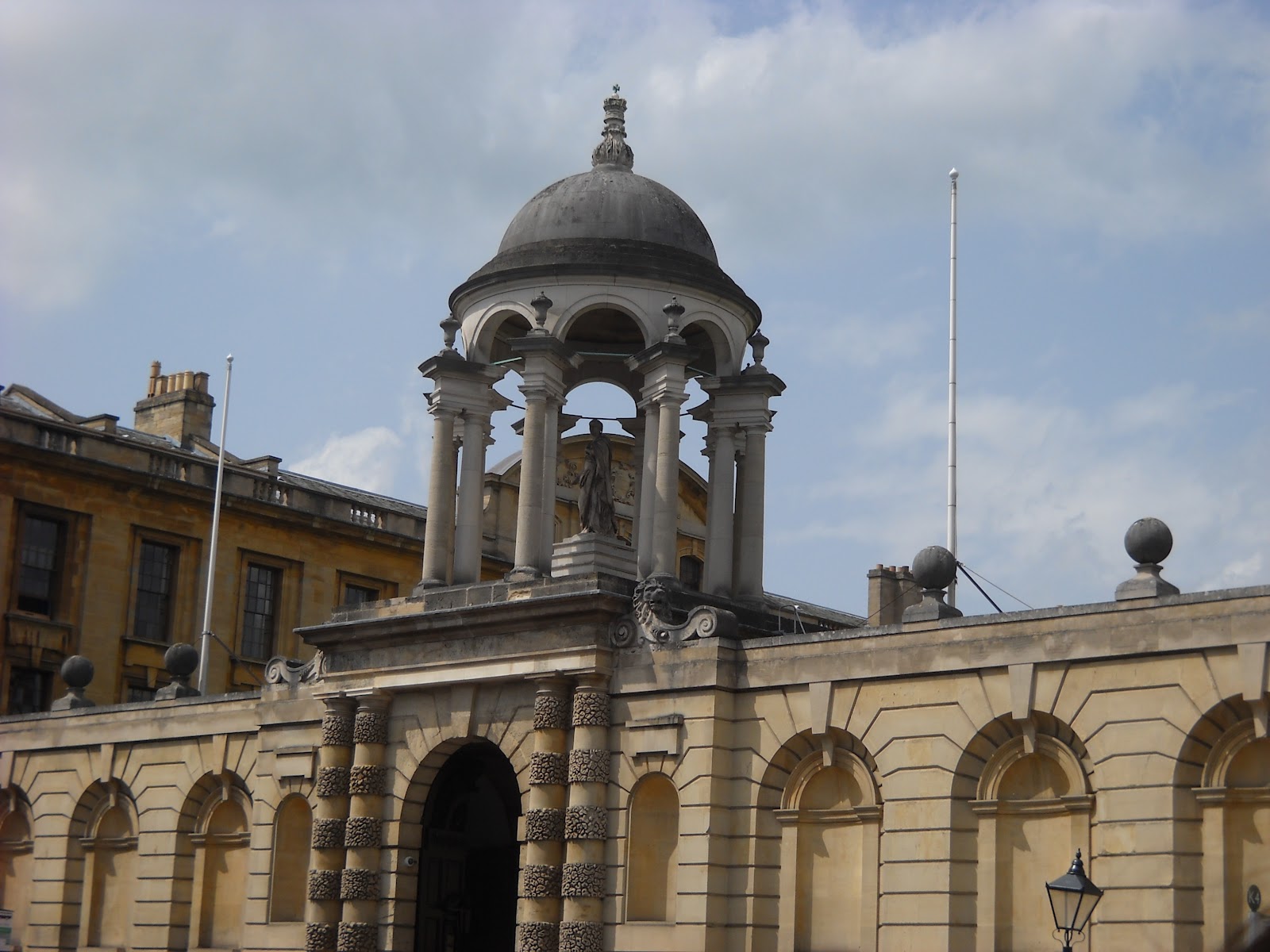
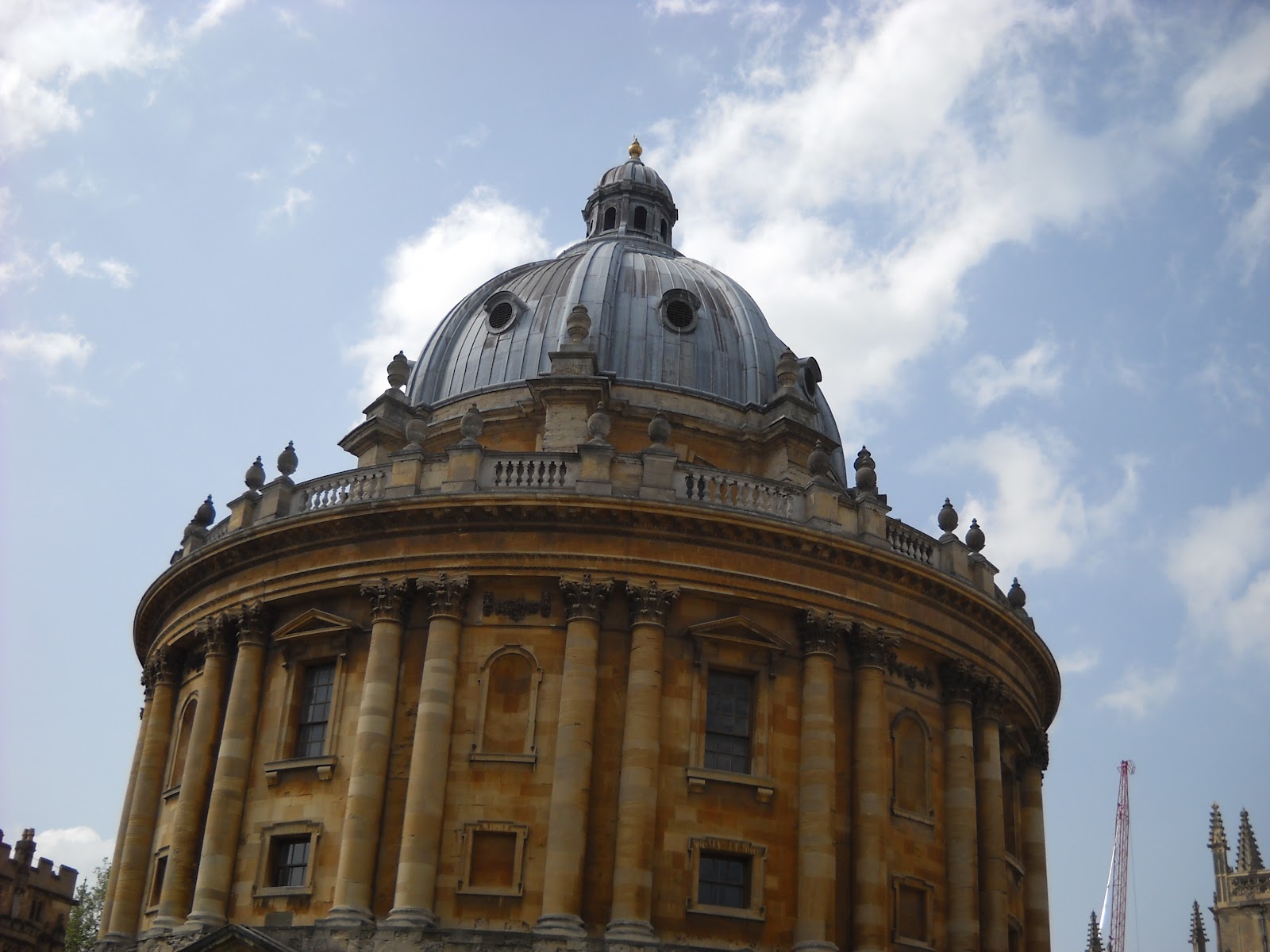
Among the most interesting locations (for me) were Merton College, the Bodlian Library, and the Radcliffe Camera. 
The Radcliffe Camera

The Bridge of Sighs. Apparently we have one because Cambridge has one, and everything Cambridge has, Oxford also must have.


Unfortunately, as it was accepted students day, we weren't able to go IN to any of the colleges, but we were able to walk around the outsides of them, which was tortuously tantalising. However, we're hoping to come back to Oxford at the end of our trip, and then maybe I'll be able to go into Merton and the others. My interest in Merton is twofold, firstly because Tolkien taught there, and secondly because if I am lucky enough to go to Oxford, chances are  I'll be at Merton. The outside of Merton, however, is quite lovely. There were even roses rambling along the back wall! 


Dear Old Merton

Merton College Chapel

one of the oldest buildings in Oxford, if I'm not much mistaken!

The Bridge of Sighs again

Didn't know Edmund Halley lived in Oxford!

The entertainingly (now) named New College, which is, in fact, quite old.


Probably Merton again

Merton Roses

Merton Chapel

The Camera again

The Bodlian!

detail of the gate of the Bodlian

Inside the Divinity School

The amazing roof of the Divinity School

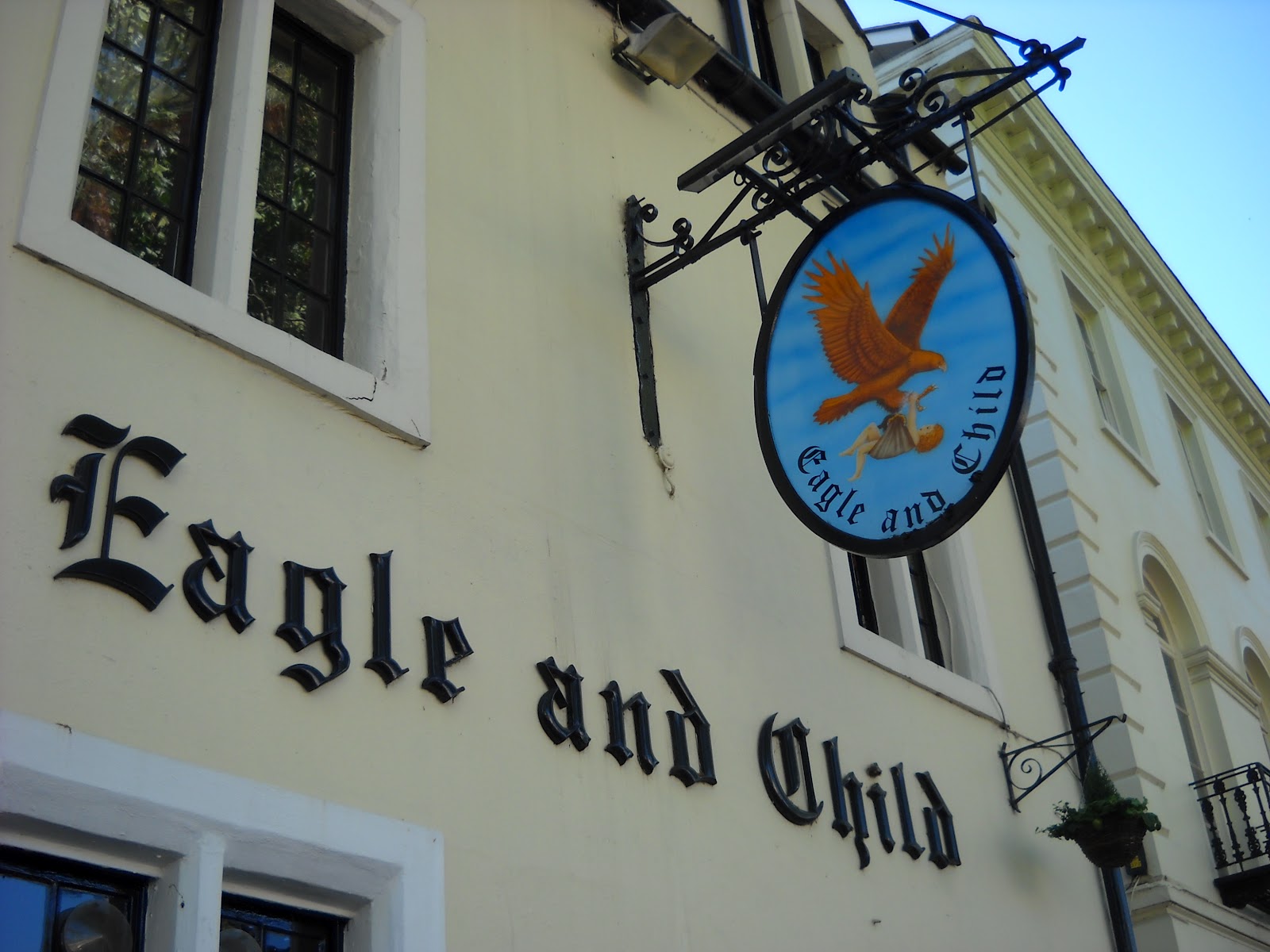
By the time the tour ended, I was completely exhausted, and warm (it was in the eighties! In ENGLAND!) and we took refuge in the Eagle and Child (aka The Bird and the Baby of Inkling fame), and sat under the plaque about the Inklings while drinking pints of lemonade. It was excellent, and just what was needed. I think my brain has failed to quite register that I was in some of the same places that Tolkien and Lewis frequented, which might explain why I'm still coherent..


You've had a whole half already!!


After we had sat there for some time, being fortified by our lemonade, and having conversed with another American girl, about my age who had also come to pay tribute to the Inklings, we drove to a charming place called The Trout Inn for dinner. 


For those of you who watch Inspector Morris (I, unfortunately, am not  one of these), our friends who ARE Inspector Morris fans had seen the Trout on the show, and were curious to see if it was good. It was indeed. First of all, the inn is HUGE, having not only an expansive indoor seating area but also an extensive outdoor seating area right on the Thames. There was also a peacock, of all things, in residence! The food was absolutely delicious, and we had the most scrumptious lemon tart for dessert.  


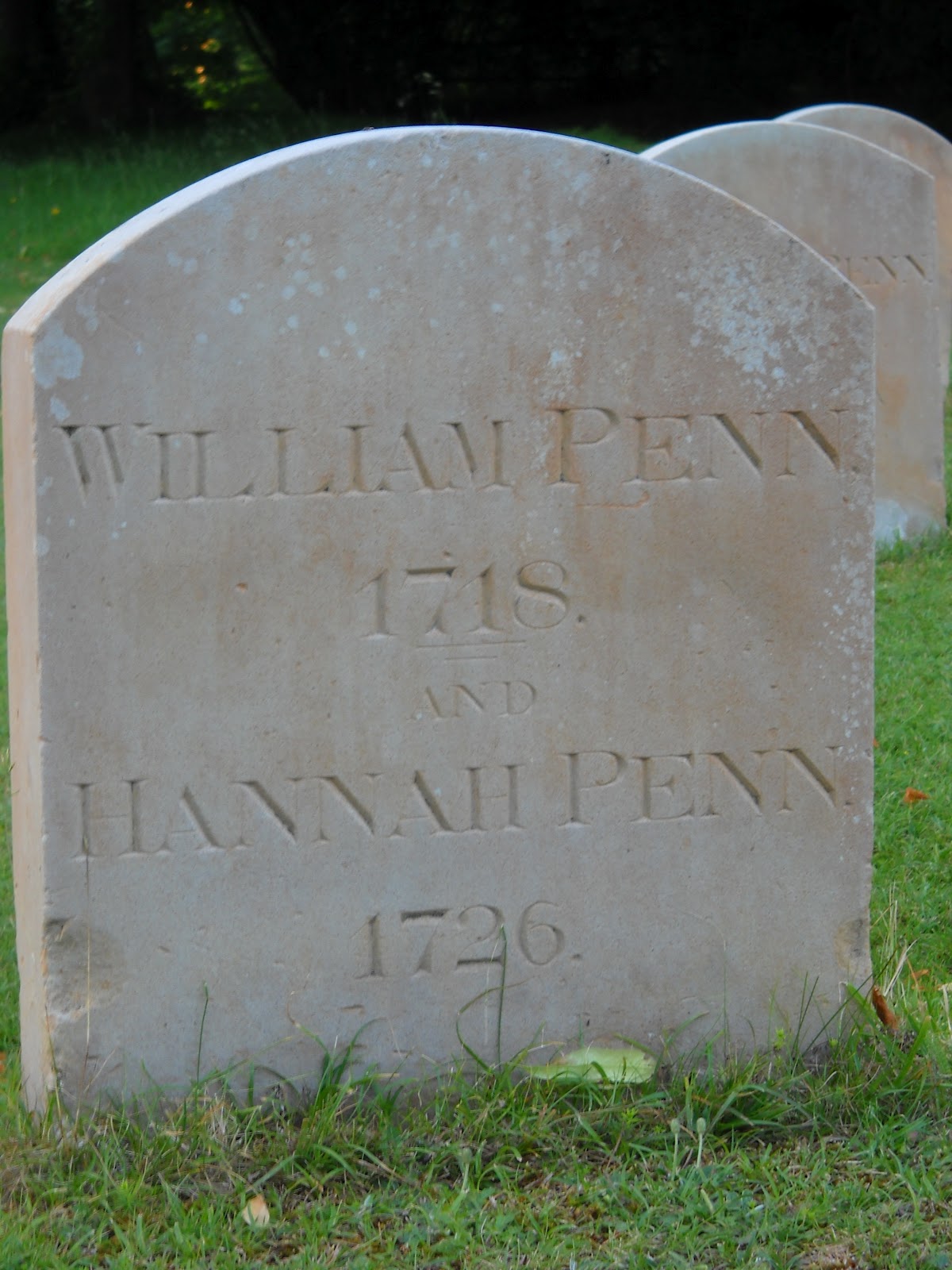
On the way back from the Trout Inn, we drove by Milton's Cottage, AND William Penn's grave. Penn's grave is on the grounds of a Quaker meeting house, which is still used today, and is not far from a barn whose structure reputedly contains beams from the Mayflower! We got back to Chalfont St Peters very late, and between exhaustion and an excellent dinner, I even fell asleep in the car! Which normally doesn't happen!


The meeting house

Milton's Cottage, unfortunately a bit blurry.
All in all, a very successful, if slightly overwhelming day! I hope we get the chance to go back and see the insides of the colleges, the library, and get out to some of Tolkien's old haunts, like the house on Northmoor Road where he wrote most of The Hobbit and The Lord of the Rings...